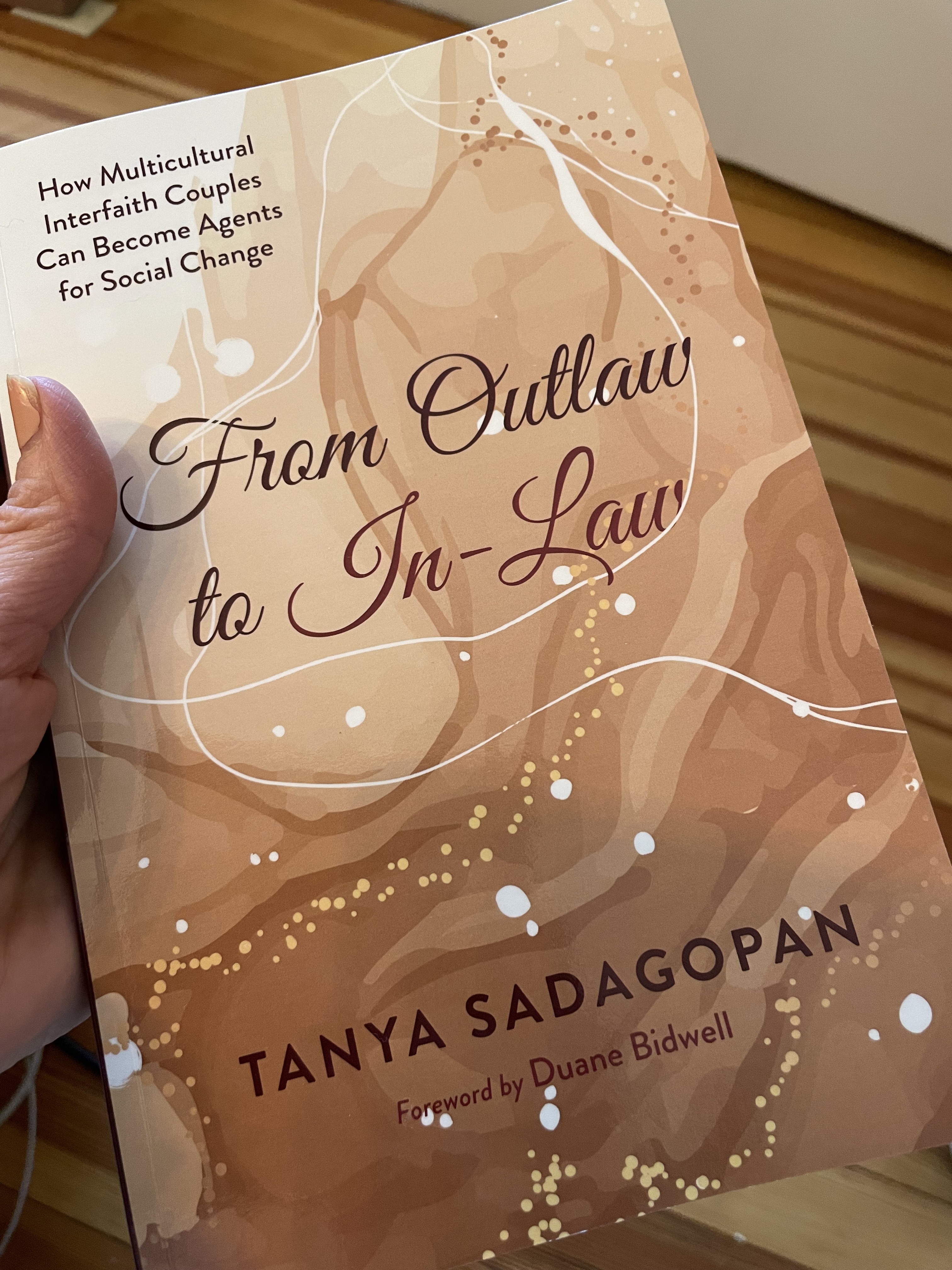
From Outlaw to In-Law: How Multicultural Interfaith Couples Can Become Agents for Social Change, Wiph & Stock Publishers, 2024,is available for purchase at your favorite booksellers.
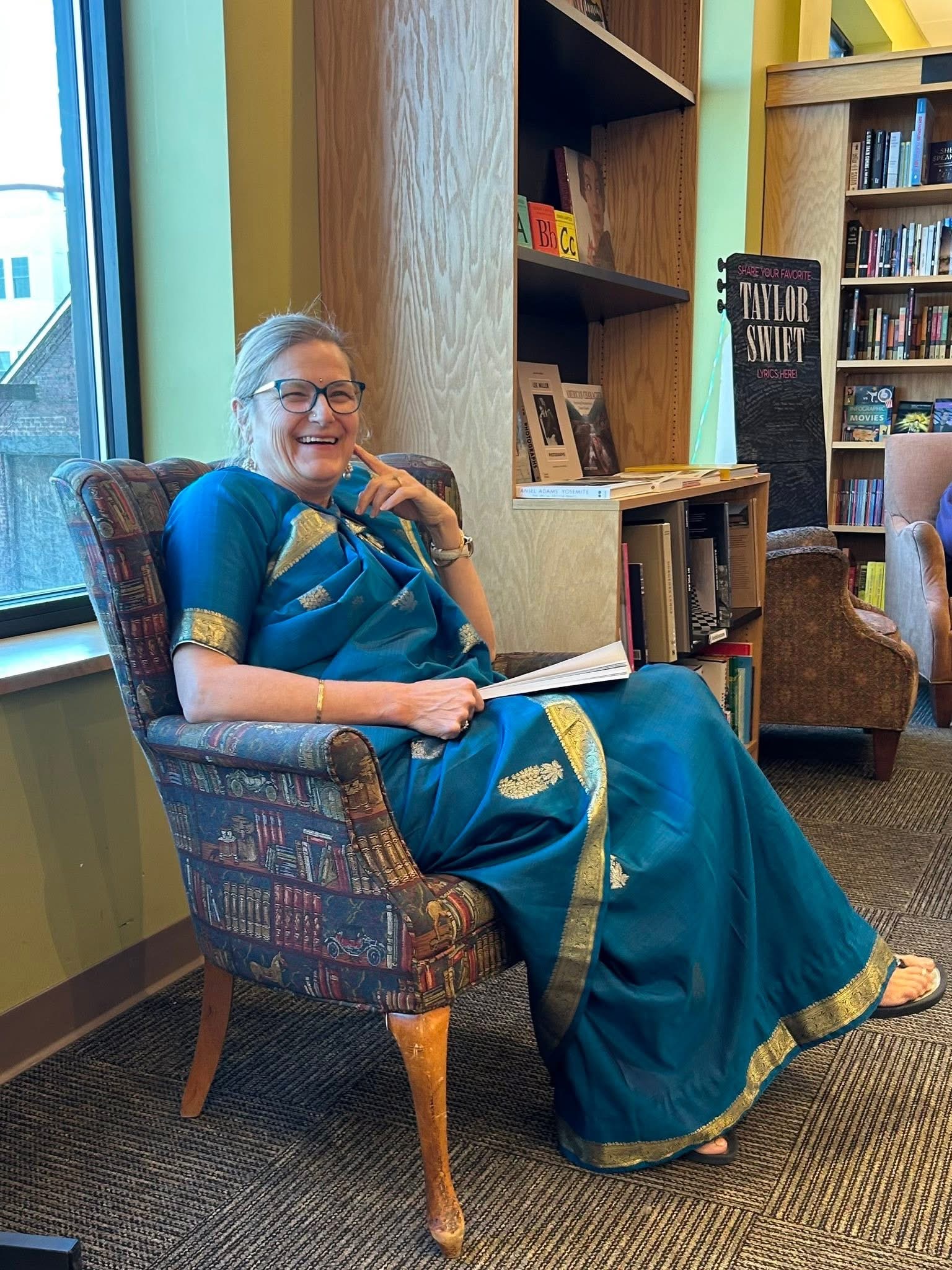
Working full time and publishing a book is quite thing to manage. My book launch has been more of a nudge into the water that some big splash! Earlier this year I had my first foray into sharing my writing and had the joy of a book signing at Gibson’s Bookstore in Concord, New Hampshire. I will have the official launch with a panel discussion at our local synagogue Temple Beth Jacob in June 7th!
The most exciting part for me sharing about my book with new audiences is learning how universal and pervasive conflict and culture wars are in our lives today. Thoughts of whom do we trust and whom do we fear seems to be lurking just under the surface. Everyday life for multicultural interfaith couples includes being met with suspicion based on race or religion, nationality or language, or some other aspect of their shared multiple identities. When we begin notice that we also experience fear of the stranger or regard those whom are different than with suspicion, we can begin to perceive the nature of the stereotypes, prejudices, and micro-aggressions that interracial and interfaith couples may face. My book helps us see the reasons for those reactions and to discover new ways of relating to people whom we may perceive as a threat to our way of life.
God created us to be connected. We all desire to belong. When we deny ourselves those connections, we lose a sense of who we are. Dealing with trauma tends to put us on edge and we are more apt to take offense at minor missteps like knocking on the wrong door.
Two years of living life in a pandemic thrust us in greater isolation than ever before. This has caused many changes in the patterns of our social participation. Subsequently, children in schools are dealing with higher levels of social anxiety and depression. They are relearning how to relate to kids their own age and their teachers. Our children have new deficits that they acquired during isolation. Our elders have also suffered from extended periods without the visits from neighbors and friends. Adults have suspended activities including attending weekly religious services. We have lost social connections that were a routine part of our lives before the pandemic. We have forgotten how to be civil. How do we reestablish our community connections?
For a little less than a year we have been working toward a new normal in our lives. People are returning to live sporting events, concerts, theatrical performances, and other communal activities. Yet have we tried to rebuild our social networks and communities of relationships? Studies suggest that participation in our faith communities increases our overall wellbeing and sense of belonging. According to the Pew Research Center, “regular participation in a religious community clearly is linked with higher levels of happiness and civic engagement,” (January 31, 2019).
God created us to be connected. We all desire to belong. Belonging to our families, to our workplaces, to our faith communities, and our friendship networks are a natural part of what it means to be human. When we deny ourselves those connections, we lose a sense of who we are. Our sense of self is diminished. Dealing with trauma tends to put us on edge and we are more apt to take offense at minor missteps like knocking on the wrong door. We are lacking a sense of safety in our communities in part because we have forgotten how to build relationships based on mutuality and trust. How do we increase trusting relationships in our lives?
Two years ago I completed my doctorate in Public Theology. To achieve this I conducted research for my dissertation exploring the difference that Multicultural Interfaith Couples make in their communities. The idea of my work proposes that the more we engage in religious dialogue with one another, and as we persevere through conflicts between race, class, gender, caste, ethnicity and economic status, the more we are able to understand and help solve some of the most complex issues in our world. How might deepening our connections between religions and working to resolve our cultural difference make a lasting difference in our communities? This is the question my dissertation explored… now it’s time to turn that work into a published book!
We live in a world filled with ethnic diversity and cultural complexity. While the trend suggests that religion is becoming less important, I believe that our faith and our willingness to talk about our differences is the stuff that makes the ways for peace. I have much work to do–editing, reading, and starting some new writing too. My manuscript is due at the end of the year.
Wish me luck and look for updates along the way right here.
Here’s the pitch that got me the contract….
Multicultural Interfaith couples face challenges that span race, religion, culture, and nationality. Through their perseverance and learned skills, they have become leaders for social change in their communities and peacemakers in their families. Juanita, a Costa Rican Catholic and David, an American Jew did not anticipate their parents moving from fear about their marriage to participating in their spouse’s religious festivals. David now leads his diversity task force and Juanita is raising their son to be both Jewish and Catholic. Another couple waited 8 years to receive their families’ blessings to marry. This is the reality for Nellie a first-generation American Sikh and her fiancé Noah, a Muslim whose mother fled the war between Pakistan and Bangladesh. Their engagement is beginning to heal generations of pain between Sikhs and Muslims. Tanya Sadagopan weaves personal stories from her research as well as her own multicultural interfaith relationship into her book. The up close and personal stories of 7 couples show how intersectionality generates resilience, insight, and skills for leadership relevant to bridging our cultural wars. Sadagopan’s research with couples from around the world shows their ability to navigate complex identities and become agents for change.This book provides families, counseling professionals, and religious leaders with insights, tools, and suggestions on how to transform fear of the religious other into curiosity to form deeper relationships that bear the fruits of social change and advocacy.
Thanks for all your support through the years for my written work. Today is a milestone in that work!
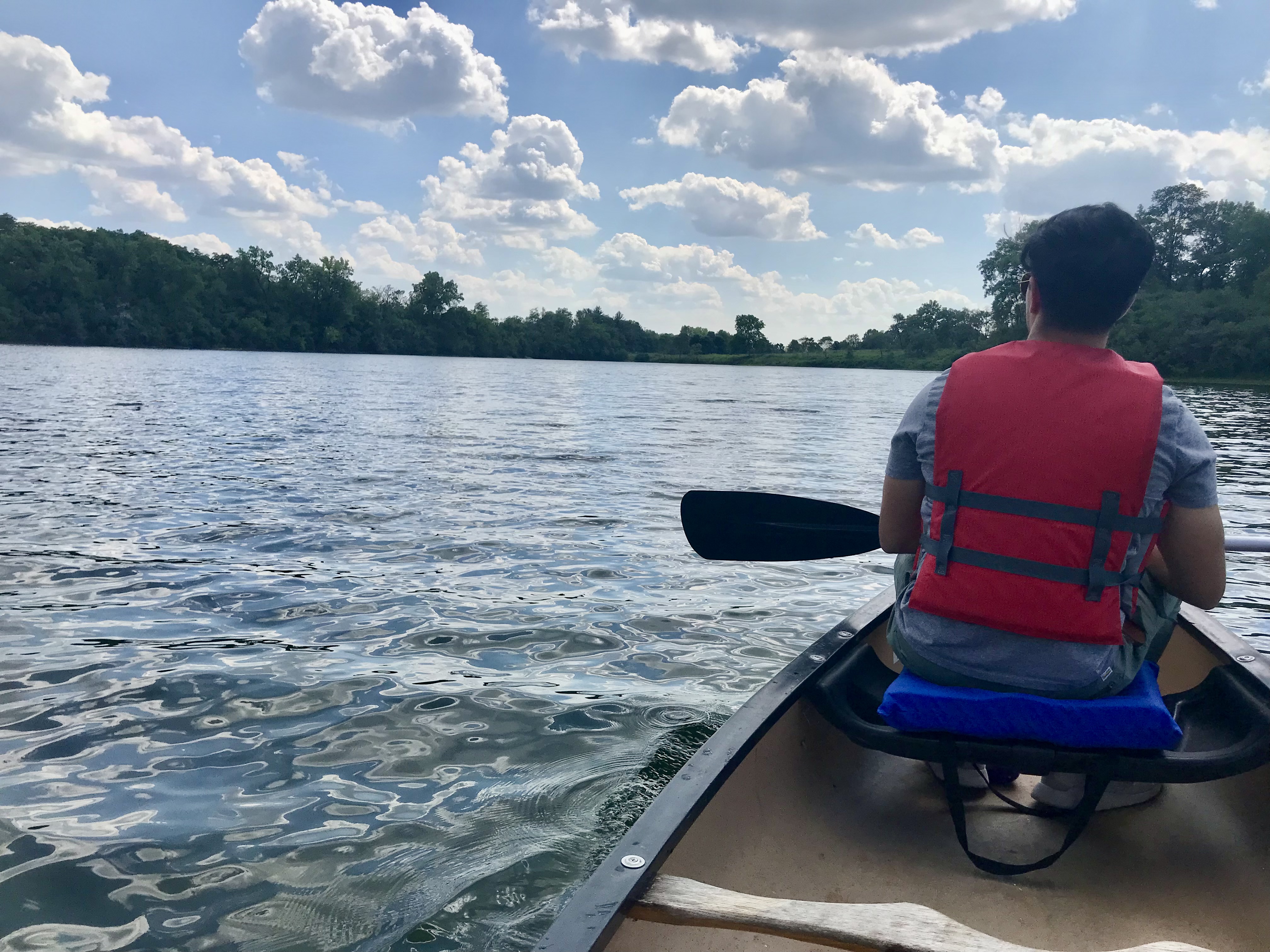
Notice blue skies, white clouds, shimmering water, stillness in the breeze, the sound of water against the oar.
When working too hard gets in the way of what we value . . .
These days of my sabbatical have given me back the gift of time–unplanned, unstructured time. And with this time my mind has had the chance to let go of producing, accomplishing, and making things happen. I am driven to do good as if time is running out. And to be honest, more than I would like to admit, I do feel like time is running out on me. I am a child of three generations of Alzheimers patients–first my granddaddy, then my mom, and now my eldest sister all suffered, and like the rest my sister will ultimately die from complications from this disease. It is hereditary. My mind constantly asks, “will I be next?”
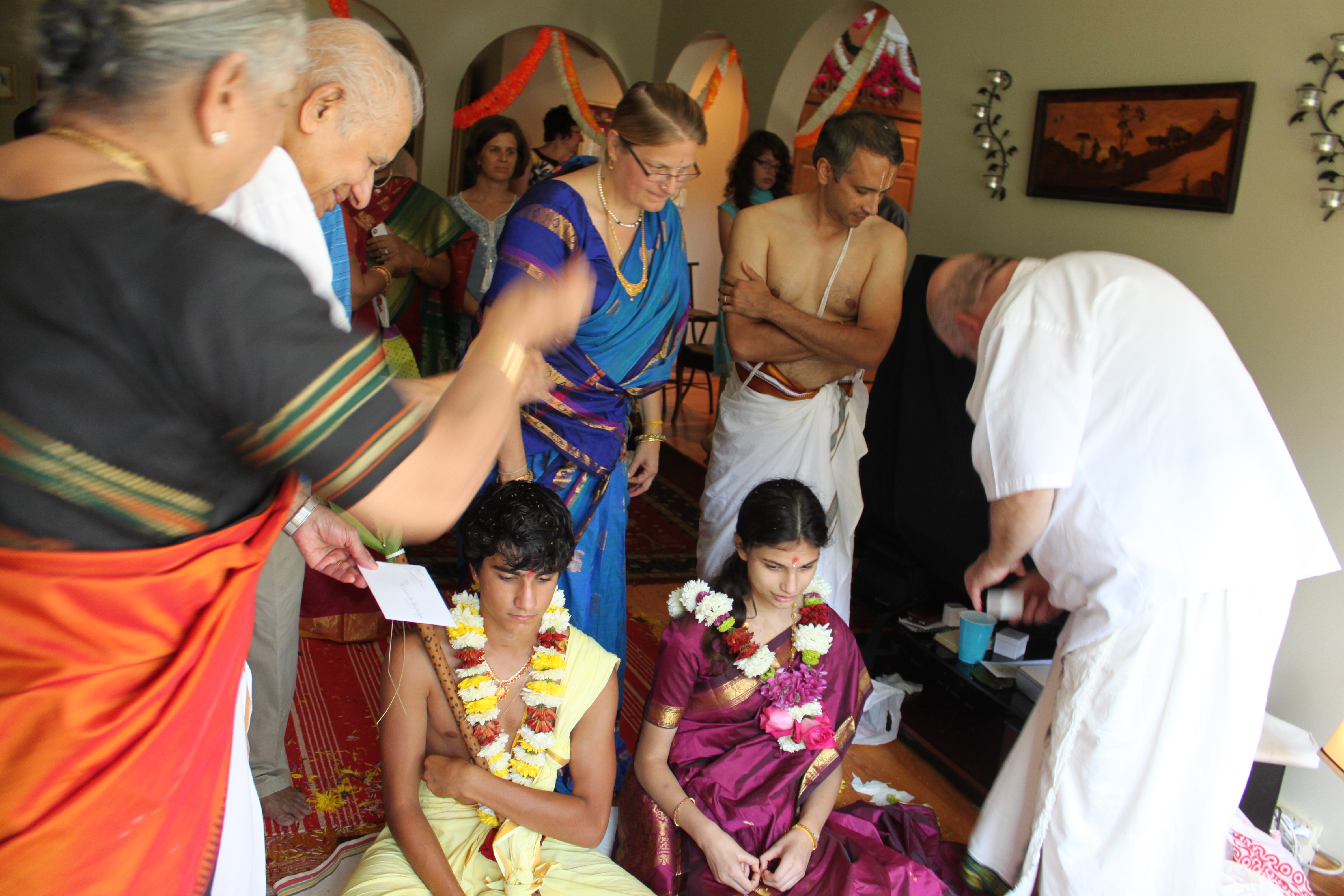
Our two children receiving the blessings of their elders at their Hindu coming of age ceremonies.
Rituals can help kids integrate both traditions.
Raising kids in two religious traditions can be quite challenging. Honoring both parents, making the grandparents happy, trying to fit it all into an already busy schedule can seem daunting. With all the challenges, many families just give up on the tradition and give in to the desire to not do anything. But in the end, wrestling to redefine what these rituals mean to our kids will benefit everyone. When we learn how to balance these different aspects of our lives, it models navigating complex situations to our children. The hassle is totally worth it.
Make the time to walk with your kid on their faith journey.
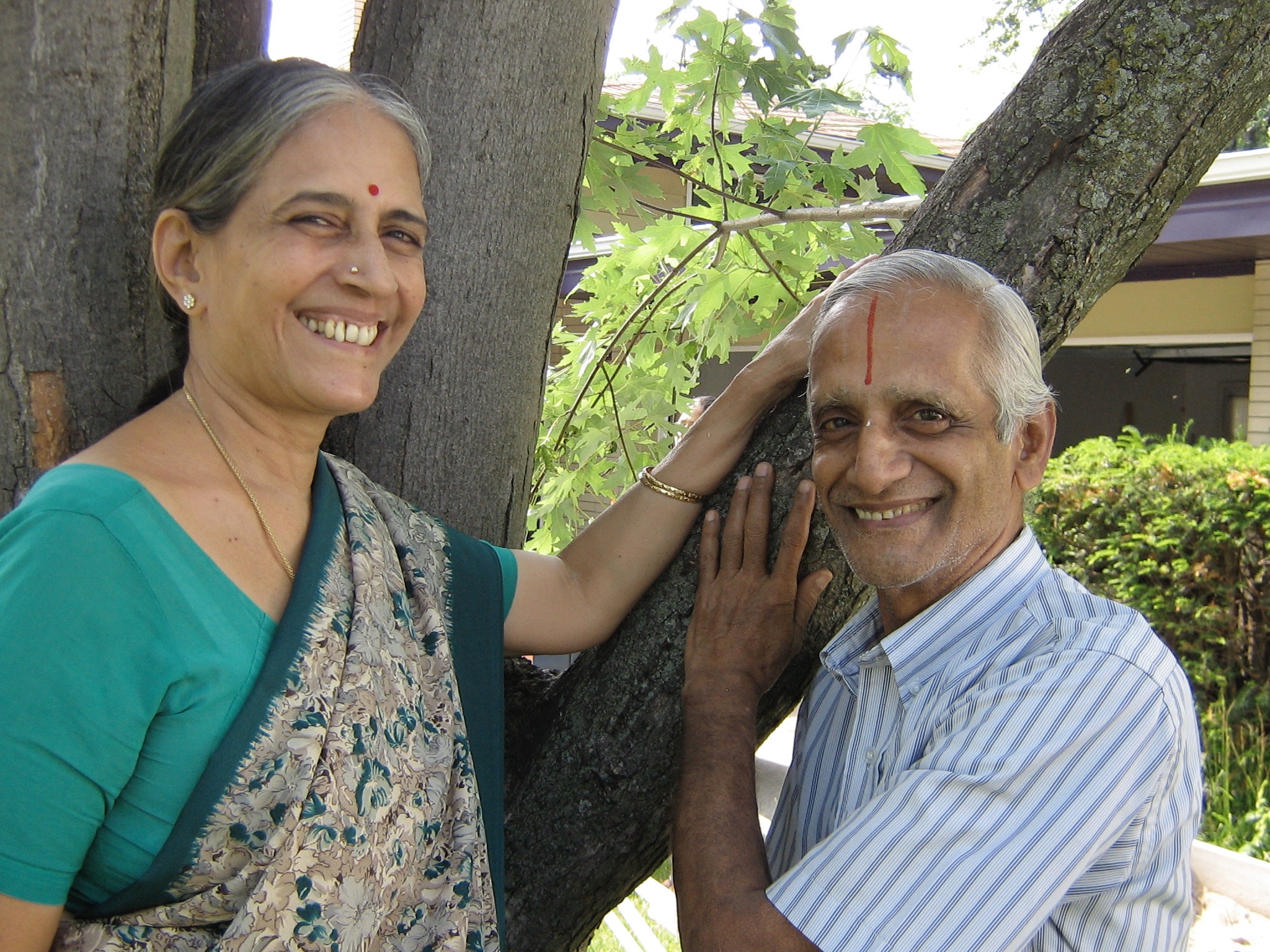
Our “Amma” and “Appa” in a rare moment when they smiled for the camera on a visit to Chicago!
How do you honor your loved ones?
Do you take time to remember the people you loved who have died? American Christians often get lost in our own grief–or worse do not know how to grieve well. The economic demands of capitalism and customs of limited time off for bereavement get in the way of remembering. Our faith suggests that a Christian burial is all that is required. We do not have rituals around remembering the dead other than the few days leading up to and including the funeral–and these days, many are choosing not to have a funeral at all. Occasionally, people will choose to honor their loved one year after they have died by spreading their ashes or gathering for a meal.
Flowers from my garden for this years’s shraddham pooja–yellow and red roses, daisies, lavender, and jasmine.
In Hindu Iyengar traditions, the rituals around remembering those who have died, especially our parents are quite specific.
Me: "Honey, why don't we renew our wedding vows..."
Him: "Why, have they expired?"
Keeping it fresh–still cultures collide.
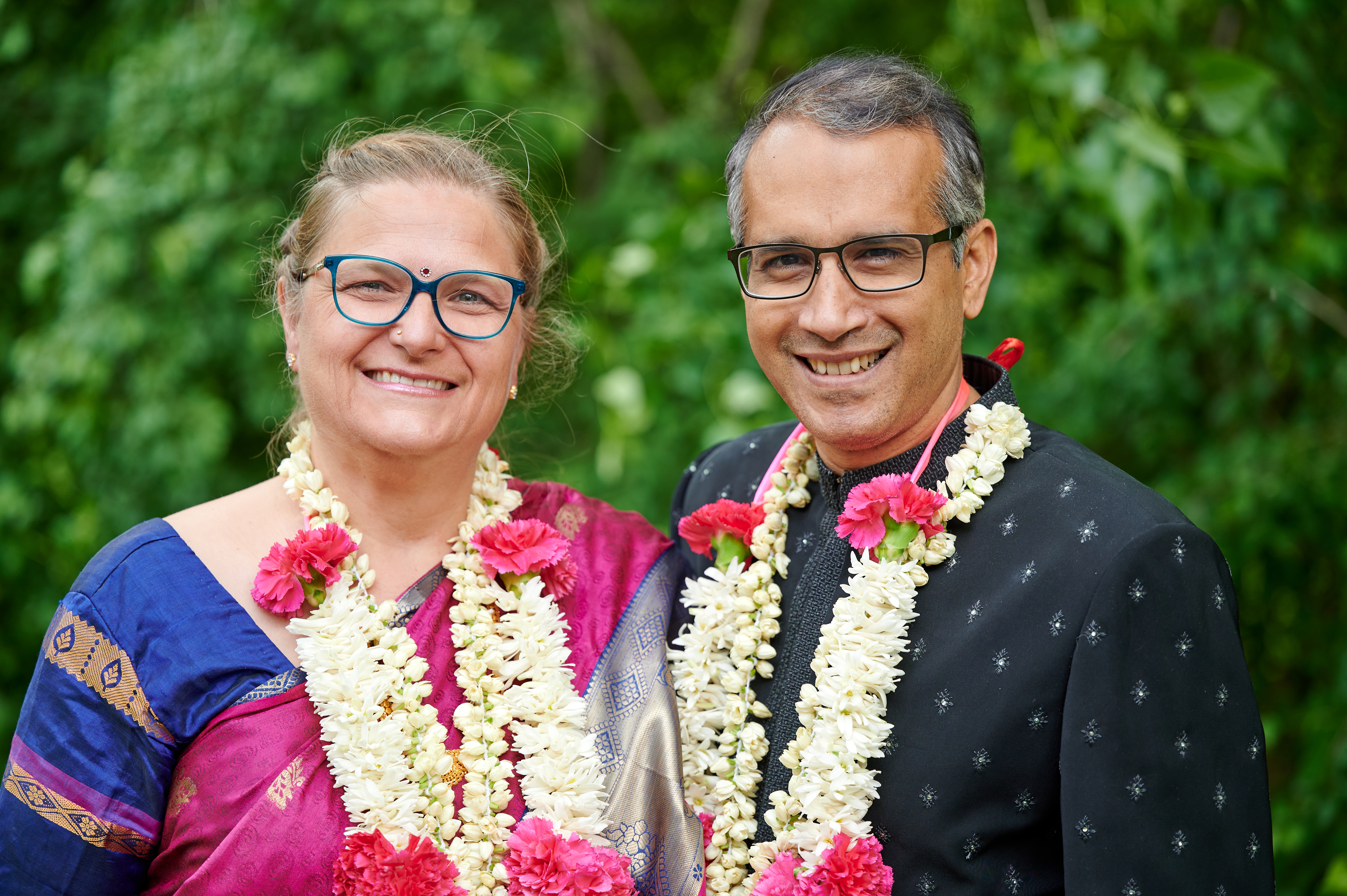
Celebrating 25 years of marriage with my husband Sriram.
We celebrated 2 weddings in 2 religions on 2 continents over 2 months over 25 years ago. How do we keep our relationship fresh while respecting and celebrating our different cultures? It isn’t easy. Americans want to go out to dinner and have grand experiences. Indians want to go to temple and receive the blessings of our elders and wear traditional clothes. Americans want to celebrate with a champagne toast. Indians want to celebrate by sharing sweets with family and friends. Like every year of our lives together we negotiated our own blended way of celebrating our 25th wedding anniversary.
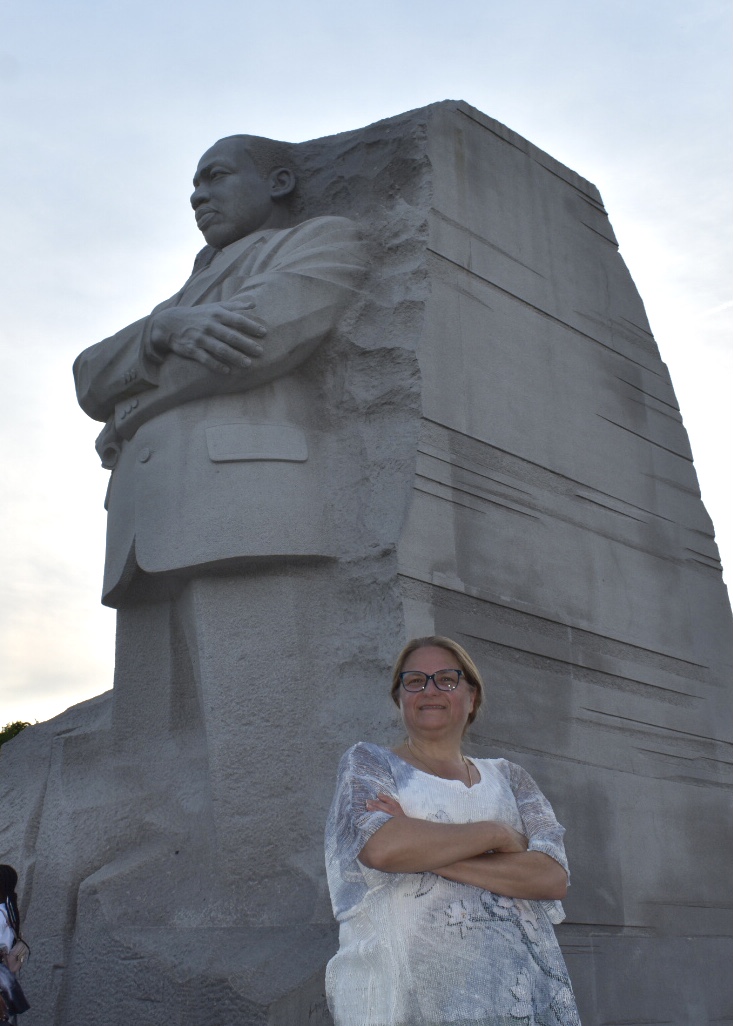
During a 2022 sabbatical visit to Washington D.C. MLK Memorial.
People’s nerves have worn thin. Parents are weary with worry. Job openings remain unfilled. Employees are working overtime to take care of increased needs and demands. They are burned out and are walking out on good jobs. We are all suffering from compassion fatigue.
I recently witnessed this as I undertook a long trip made longer by frayed ends and frazzled emotions. Carefully, I watched travelers and airline staff alike, all doing their best and losing their cool. We are under stress—high levels of expectations with new protocols and a river of fear running through it all. Leaders of all kinds have seen the worst end of ugly and received the angry brunt of a public who has lost all hope that their life can be restored to a time before the pandemic began.
When we celebrate Deepavali every year, we focus on what we will give.
It starts with birthdays. In India the question is, “What will you give in honor of your birthday?” In America the question is, “What will you get for your birthday?” Getting versus giving, this is the fundamental shift in understanding between our competing cultures of Indian values verses American values. In our multicultural interfaith family, we deal with this tension between giving and getting, sharing and receiving, serving and being served. By celebrating both Deepavali and Christmas, star birthdays and date birthdays, attending temple and churches we have strived to teach our children the values of service and activism.
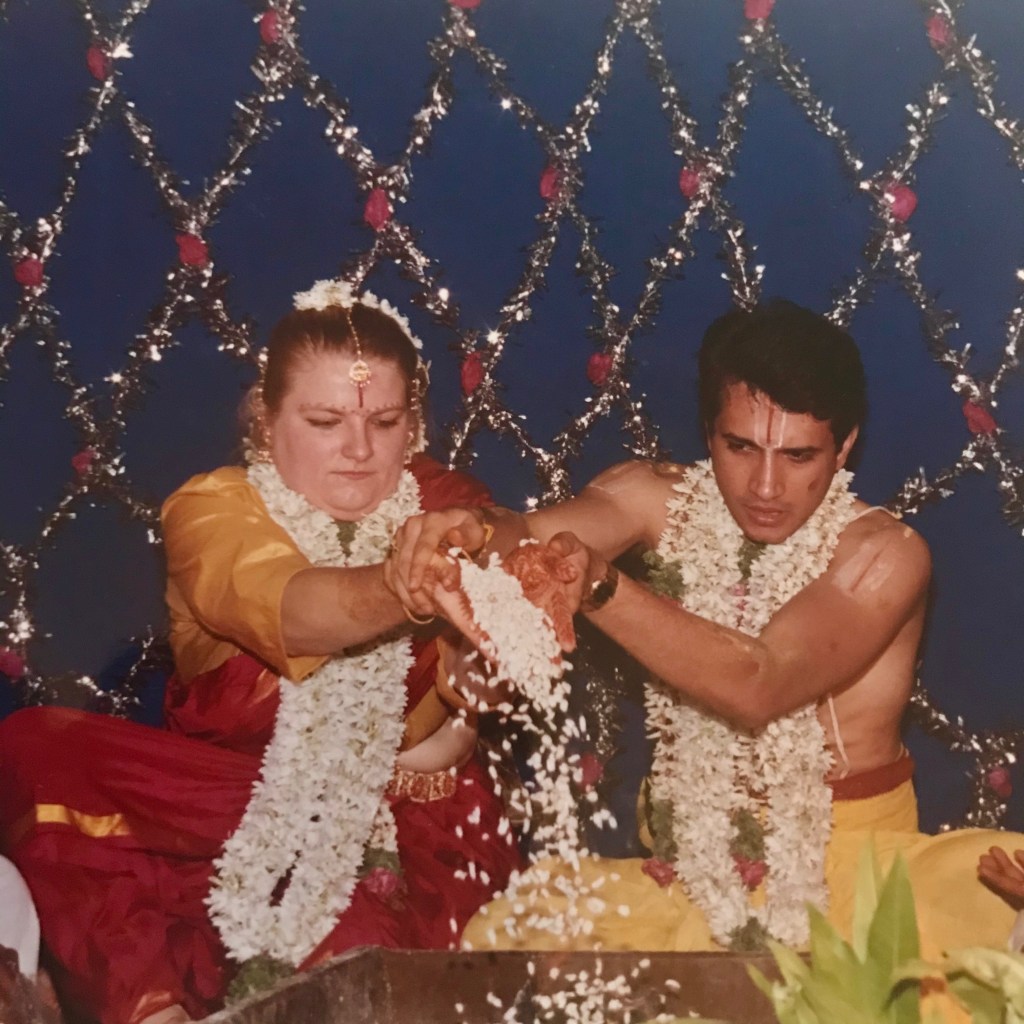
Offering puffed rice into the Agni fire during the Hindu Marriage Rites in Madras, India January 19, 1997.
What do you do when cultures collide?
When people from India meet us for the first time, at some point they ask the inevitable question, “How did you meet?” They look at my husband a handsome brown man from Bombay who speaks Tamil, Hindi, English and some Gujarati—’enough Gujarati to eat,’ we say—and then they look at me, an outspoken curvy white woman from the American South with blonde hair and they can’t imagine why or how we became husband and wife. My husband of now 23 years should have had an arranged marriage by his parents to a nice, black haired light-skinned South Indian Tamil Iyengar woman who was trained in either Bharatanatyam dance or perhaps she was trained to play the stringed musical instrument called the vena. She would have been educated, had a professional job likely in business, would have been younger by 3 years, and also she would be strikingly beautiful, Bollywood worthy, and even then, she would have not been good enough for their first born son.










 Every Day Life, Every Day Faith